A Heart-to-Heart Guide for Parents
Can I be honest with you for a second?
When my friend’s daughter started reading before her third birthday, I felt that familiar pang of worry. “Am I doing enough? Is my child falling behind?” Maybe you’ve felt it too.
But here’s what I’ve learned after years of watching children learn to read: there’s no magic formula, no secret trick. Just a loving parent (that’s you!), a simple roadmap, and the willingness to take it slow.
So grab a cup of coffee, settle in, and let me share what actually works when teaching little ones to read.
Phase 1: Laying the Groundwork (Before Any Letters Appear)
The Foundation Nobody Talks About
You know what? Most parents jump straight to flashcards and alphabet songs. But the kids who become confident readers? They started somewhere else entirely.
Here’s what your child really needs first:
- An ear for sounds and rhythms
- Eyes that notice details in pictures
- The ability to express thoughts in sentences
- A feeling that books are friends, not work
What this looks like in real life:
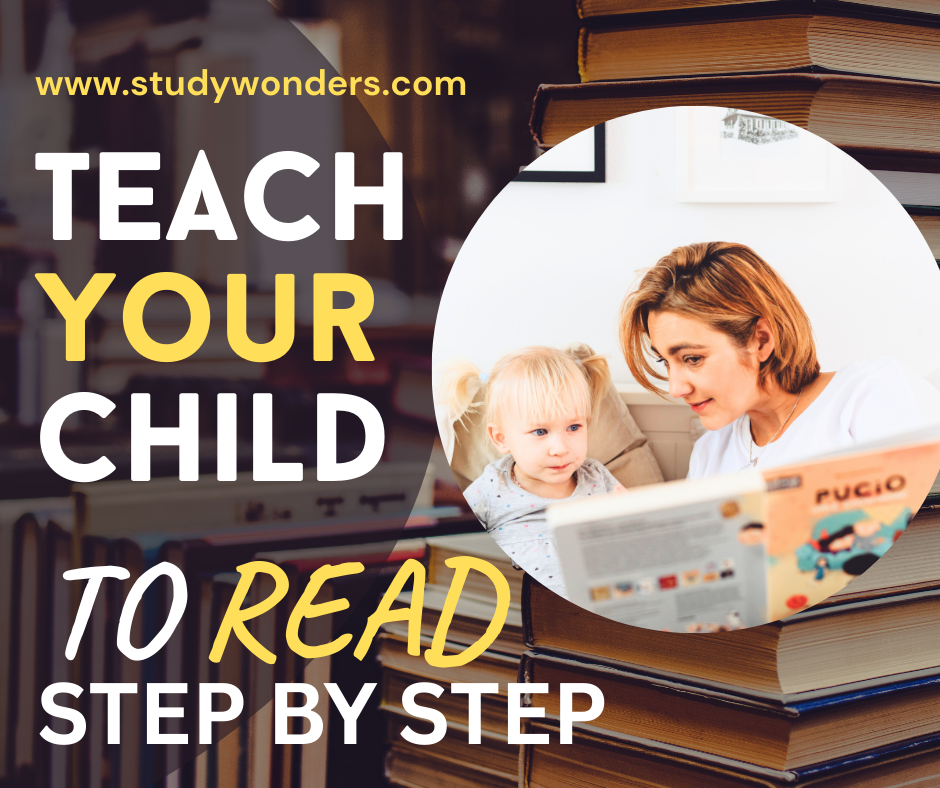
Picture this: you’re curled up on the couch together, going through a picture book. You’re not teaching. You’re not quizzing. You’re just… enjoying it. That’s the foundation right there.
Try these tonight:
- Make storytime sacred – same time, same cozy spot, every day
- Belt out silly nursery rhymes while folding laundry or driving
- Point at pictures and wonder out loud: “Hmm, what’s that little mouse thinking?”
- Turn sounds into games – “Can you roar like a lion?” “What noise does our car make?”
Here’s the relief: Your child doesn’t need to recognize a single letter yet. This stage is about falling in love with language, stories, and the rhythm of words. That’s it.
Phase 2: Meeting the Alphabet Family
When Letters Stop Being Squiggles and Start Having Names
Alright, now we’re ready for the alphabet. But listen – I’m going to save you some frustration right now.
Here’s the approach that actually sticks:
Start with the BIG letters (capitals). Why? They’re bolder, clearer, easier for little eyes to distinguish. Think of them as the “easy mode” of the alphabet world.
The secret nobody tells you: Don’t teach all 26 letters in one go. I learned this the hard way. Five or six letters at a time – that’s the sweet spot. Let your child own those letters before moving on.
Make it playful:
- Stick alphabet posters in the bathroom (yes, really – they’ll stare at it daily!)
- Create flashcard games: “Find the B! You found it – high five!”
- Let them trace letters in shaving cream, sand, or finger paint
- Play detective: “Can you match this M with something that starts with M?”
Real talk: Some letters will click immediately. Others might take weeks. The letter “b” and “d” confused my nephew for months. That’s completely normal. Just keep it light.
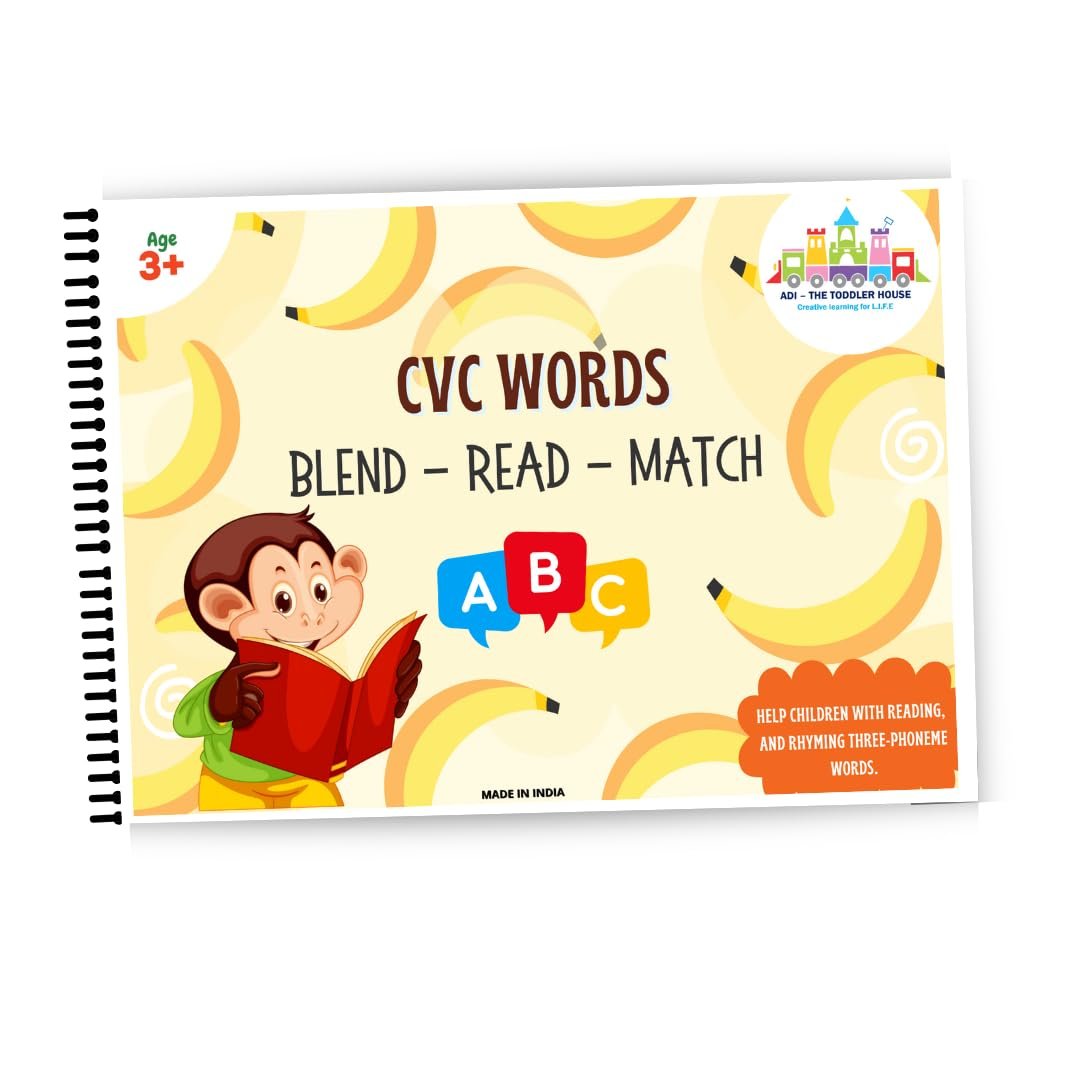
CVC WORDS |BLEND-READ-MATCH|- 22 Word families – Phonics binder | Early reader | 3 letter word book
Phase 3: Unlocking the Sound Code
This Is Where Reading Actually Begins
Okay, lean in close because this is the part that changes everything.
Letters have sounds. Not just names – sounds. And once kids crack this code? The whole reading world opens up.
The mindset shift:
When you see the letter B, don’t say “bee.” Say the sound: /b/ (like the beginning of “ball”). This is phonics, and honestly, it’s the breakthrough moment.
Where to start:
These six sounds are golden: s, a, t, p, i, n
Why these? Because you can mix and match them into dozens of actual words. Sit, sat, pin, pan, pat, pit, nap, nip, tap, tip… you get the idea.
Activities that make it click:
- Give each sound a motion – stomp for /s/, wiggle for /w/
- Play “I Spy” with sounds: “I spy something that starts with /t/”
- Go on sound scavenger hunts around the house
- Make silly mistakes on purpose: “Does ‘dog’ start with /b/? No? What does it start with?”
The hard truth: This phase takes longer than you think it should. Some days your child will nail it. Other days, they’ll forget sounds they knew yesterday. Don’t panic. Their brain is literally rewiring itself. Give it time.
Phase 4: The Magical Moment – Blending Sounds Together
When It Suddenly Becomes Reading
This is it. This is the moment that makes you want to call everyone you know.
Your child is about to blend sounds and read their first word.
Here’s how it unfolds:
You show them: c… a… t
You help them push those sounds together: c-a-t… cat.
And then – wait for it – they read “cat” on their own.
Start simple with three-letter words:
- cat, bat, mat, hat
- dog, log, fog, hog
- sun, run, bun, fun
Techniques that work wonders:
- The finger slide method: Touch each letter as you say its sound, then slide your finger under the whole word as you blend
- Word families are magic: Once they read “cat,” show them “hat,” “mat,” “bat” – their confidence will soar
- Keep it bite-sized: Five minutes of blending practice is better than 30 minutes of frustration
What to expect: Your child will get stuck. They’ll guess. They’ll mix up sounds. This is THE hardest part of learning to read. Celebrate every tiny victory. “You sounded out the first two letters – great start! Let’s try it together.”
Phase 5: Stringing Words Into Sentences
When Letters Become Stories
Once your child can decode simple words, it’s time to put them into sentences. But we’re not jumping into chapter books yet.
Start with sentences like these:
- “I see a cat.”
- “The dog can run.”
- “This is my cat.”
Now introduce sight words:
These are sneaky little words that don’t follow the phonics rules: I, the, is, see, can, my, you, we
Your child needs to recognize these instantly, without sounding them out.
Make it easier with these tricks:
- Use books with pictures that support the text (the picture shows a cat when the sentence says “cat”)
- Put your finger under each word as they read – this builds tracking skills
- Read the same simple book five times if needed – repetition is your friend
Mindset check: When your child makes mistakes, resist the urge to immediately correct. Let them finish the sentence, then gently go back: “Let’s look at that word again together.”
Phase 6: Reading Like a Reader
From Choppy to Smooth, From Words to Understanding
There’s a difference between sounding out words and actually reading. You know it when you hear it – the sentences flow, there’s expression, they actually understand what’s happening in the story.
Two goals here:
- Fluency – reading smoothly without pausing at every word
- Comprehension – understanding and remembering what they read
How to build both:
For fluency:
- Reread favorite books until your child can read them smoothly (yes, the same book ten times!)
- Model expressive reading – show them how to make it sound like talking
- Don’t interrupt during reading unless they’re completely stuck
For comprehension:
- After reading, chat about it: “What was your favorite part?” “Why do you think the character did that?”
- Act out scenes together with stuffed animals or action figures
- Ask them to tell you the story in their own words the next day
Truth bomb: Some kids read fluently but don’t absorb a thing. Others understand every detail but read slowly. Both are normal. Both improve with practice.
Phase 7: Growing a Reader for Life
It’s Not About the Skill – It’s About the Love
Here’s what keeps me up at night: I don’t want to raise a child who can read. I want to raise a child who chooses to read. Who reaches for a book when they’re bored. Who gets lost in stories.
That doesn’t happen by accident.
Create the habit:
- Protect reading time – Ten minutes before bed, no exceptions, no screens allowed
- Let them choose – Even if they pick the same dinosaur book 47 nights in a row
- Never use reading as punishment – “No iPad until you read!” creates resentment
- Make it cozy – Blankets, pillows, a special reading lamp, hot cocoa
The environment matters:
Kids who love reading often grow up in homes where they see adults reading. Not just on phones – actual books, magazines, newspapers. Be the reader you want them to become.
Celebrate milestones without pressure:
- First word read? Do a happy dance!
- Finished a whole book? Ice cream celebration!
- But if they struggle? Still celebrate the effort: “I saw how hard you tried today. I’m proud of you.”
Your Roadmap at a Glance
Here’s the journey in order:
- Build listening, speaking, and a love for books
- Learn to recognize letters by sight
- Discover that letters make sounds (phonics)
- Blend those sounds into words
- Read words in sentences
- Read smoothly with understanding
- Develop a lifelong reading habit
Before We Part Ways – Some Real Talk
Keep sessions short. Fifteen minutes of focused, happy reading beats an hour of tears and frustration every single time.
Visual helps. Colorful charts, fun worksheets, magnetic letters on the fridge – kids learn with their eyes.
Repetition isn’t boring to them. It’s comforting. Read that same book again. Practice those same sounds again. It’s working.
Be kind to yourself. Some days you’ll feel like a rockstar teacher. Other days you’ll want to give up. Both are part of the journey.
Make it joyful. The second it stops being fun, take a break. Go play outside. Come back tomorrow. Reading should never feel like a battle.
One Last Thing
Your child will learn to read. They will. Maybe faster than you expect, maybe slower. Maybe in a straight line, maybe with detours and backtracking.
But they’ll get there.
And years from now, when you see them curled up with a book, completely absorbed, lost in another world? You’ll remember these early days. These read-alouds, these first words, these small victories.
You’re not just teaching sounds and letters.
You’re opening doors to every story, every idea, every adventure that’s ever been written down.
That’s pretty incredible.
So take a breath. You’ve got this. One sound, one word, one page at a time.
Where is your child right now in their reading journey? Wherever they are is exactly right. Start from there. The rest will unfold.
Happy reading, friend.